Trust-Based Philanthropy Was Never Just About the Practices
By Shaady Salehi
When we first introduced trust-based philanthropy, we focused on practices.
We offered a clear framework: multi-year, unrestricted funding; streamlined paperwork; transparency; and support beyond the check. Those practices gave funders a tangible, actionable roadmap to cultivate trust amid power imbalances.
But these practices were never the destination. They were a doorway toward redefining the role of funders—not as the hero of the story, but as one player among many, helping create the conditions for people and communities to thrive.
I recently discussed this with Mia Reilly of Tara Health Foundation as part of their Make Shift Happen conversation series. In reflecting afterward, Mia wrote something that perfectly captures the essence of trust-based philanthropy: There is no moment when a foundation becomes "trust-based enough." It is an ongoing practice.
That simple idea gets at the heart of what we at the Trust-Based Philanthropy Project have come to describe as the iceberg journey. The trust-based practices are the visible tip of the iceberg—the part that's easiest to see, adopt, and measure. They are explicitly about how funders show up in order to create more equitable experiences for nonprofits. This is incredibly important work, and a great place to start.
But beneath the surface is where real transformation happens. Underlying the practices are our organizational cultures—the norms, incentives, and unwritten rules that shape how we make decisions and influence how power is exercised every day. And at the foundation are our values and mindsets: what we believe philanthropy is for, whose expertise we trust, and what role we believe funders should play in creating change.
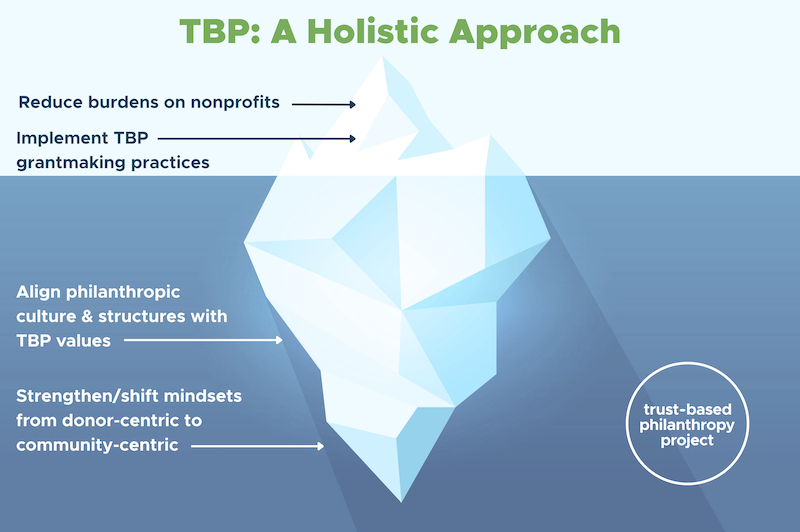
This is where the deeper work happens. It's where we ask questions that don't have simple or permanent answers:
Where are we holding onto power, and what are the biases and assumptions that keep us from letting go?
How do our systems reflect—or contradict—our values?
How can we use our power and privilege to create the conditions for others to thrive?
These aren't questions we answer once. They're questions we return to again and again, because every layer we explore opens new possibilities—for ourselves, for our institutions, and ultimately for the people and communities we serve.
At the Trust-Based Philanthropy Project, we have witnessed that as funders deepen their practices, they begin to see themselves differently—not as experts with the answers, but as partners who create space for others to lead. Institutions become more responsive, more trustworthy, and more aligned with the values they aspire to uphold. In turn, communities gain greater agency to shape the solutions, strategies, and futures they know are possible.
This is why we often say that trust-based philanthropy is a journey, not a checklist. The practices may open the door, but the deeper work keeps moving us forward.
And that’s kind of the whole point.
Shaady Salehi is a Senior Fellow at the Trust-Based Philanthropy Project.