By Pia Infante
“There's no use trying,” Alice said. “One can't believe impossible things.”
“I daresay you haven't had much practice,” said the Queen. “When I was your age, I always did it for half an hour a day. Why, sometimes I've believed as many as six impossible things before breakfast.”
- Lewis Carroll, Through the Looking Glass
I daresay that we’ve all experienced more impossible things than we can count on 10 fingers in the past month, much less in the past few years. Yet the math of impossible becoming possible is changing once more.
For many, the midterms brought to fruition what had been feeling impossible. Not just the electoral surprises, but making visible a kind of leadership that has felt lacking at the national level: community-accountable, humble, empathetic, principled, kind, and multi-dimensionally diverse. For us, that’s trust-based leadership.
I’m delighted to end the year wondering: What impossible things can be made real via collective imagination and leadership, now? Here are some of the lessons sitting with me.
Leaders > Institutions
Trust-based philanthropy has most of its roots in institutional philanthropy, specifically in a desire to defy convention: to be more community-centered, to be better partners and collaborators. But this year it became clear that the staying power of trust-based philanthropy depends perhaps less on the institution than on the leadership.
A trust-based leader can move from institution to institution, or even step outside of institutions altogether, and remain deeply influential. Alternatively, when a trust-based leader leaves an institution, even one with infrastructure that should keep trust-based practice going, those practices can disappear unless the incoming leadership is deeply committed.
This contrast underscores a strategic focus for us at the Project: investing in TBP champions, wherever they are now and wherever they may be in the future. These leaders embody trust-based values, often bring experience as practitioners, and will champion this way of collaborating—from any seat, at any table. Impossible isn’t in their vocabulary.
Foundations ≠ Philanthropy
Ten years ago, when I was leading The Whitman Institute and our grantee partners leaned on us to try to influence the philanthropic sector, I thought, “Well, that’ll be impossible.” What funder would alter their approach because a small foundation in California promoted relationships of mutual trust and long-term investments not just of money but time, support, and attention?
It turns out that it was, in fact, quite possible. A group of credible, dedicated foundation leaders deployed relational capital and stories of experience to activate The Trust-Based Philanthropy Project, which has outlasted even their own tenures in those original institutions.
Small to midsize philanthropies can and do have an outsized impact on moving the sector to pay attention to the needs and dreams of nonprofits and the social movements they help carry. Believe in them! Among the 150,000 private foundations in the U.S. (or about 190,000 if you include community, corporate, and other grantmaking public foundations), most would be described as “small” like The Whitman Institute.
“Small to midsize philanthropies can and do have an outsized impact on moving the sector to pay attention to the needs and dreams of nonprofits and the social movements they help carry. ”
More and more, though, foundations are not the whole story when it comes to philanthropy. As different wealth flows become viable for charitable giving, the kinds of platforms donors give from are proliferating. DAFs and LLCs are growing fast and are often used alongside foundations rather than replacing them outright. Research shows younger donors are twice as likely to choose DAFs as older generations.
At the Project, we’re exploring where and how trust-based values translate into different giving vehicles. For example, can a DAF be trust-based? Are recoverable loans or landback initiatives already intrinsically trust-based?
Stay tuned for some experiments we’ll run with other friendly disruptors in the next six months.
Scale = Depth Over Breadth
We now have TBP funder action cohorts in roughly 12 cities/regions. It’s been powerful to witness how swiftly the leadership of one or two TBP champions can magnetize collective conversation about regional action.
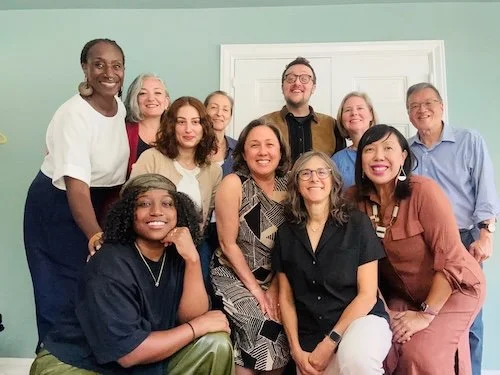
The New York City Trust-Based Philanthropy cohort
The typical “scale” move would now be to double or triple the number of cohort locations, but we’re defining scale as depth versus breadth. For the Project, it isn't about scaling for scaling's sake. It's about the depth of leadership, the depth of the regional bench, and being in generative connection with values-aligned, multi-sector efforts in the regions.
Plus, some cities are already oversaturated with initiatives to bring funders into community accountability and alignment. We’re looking for the overlooked places and champions. We’re interested in regions with less funder and nonprofit infrastructure, and opportunities to connect with values-aligned regional efforts.
We will continue to support and lift up the leadership of champions in the network, and keep ears to the ground where opportunities to build and collaborate emerge. Who knows what "impossibilities" might become possible?
The hope is that over time regional cohorts become strong hubs of trust-based practice and advocacy, and eventually a national organization may not be necessary to sustain this work in the long run.
We ≠ Machines, & Humans > Machines
While the global question remains around whether AI is going to take over the world, it can never replicate the heart and hope that humans hold. Our ability to believe in the impossible, to listen to and harness our gut feelings to push into uncertainty—even if it makes us seem a little irrational at times—is one of the (many) beautiful things about humanity. I’ll take humans over machines any day.
I’ll end this reflection by honoring the humans at the center of the Project, the network, and the movement. On the TBP team, we prioritize cultivating and sustaining a culture of wellness as a collective, rather than expecting wellness to happen on an individual front. This year we sought to cultivate that, and we encourage it as a principle for everyone in this network and beyond.
We all need rest, creativity, connection, and community. We are not machines. Overwhelming and overcommitting ourselves doesn't make our strategy stronger; in fact, it gets in the way.
These are some of my end-of-year reflections. I'd love to hear yours. What are you carrying forward? What are you leaving in 2026? What are six impossible things you hope to bring to fruition in 2027?
Most of all, I hope you're heading into a winter break that is deeply restorative. You deserve it.
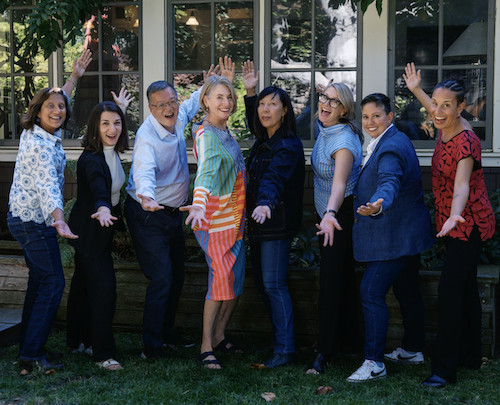
Happy holidays from the TBP Project steering co.
Pia Infante is Executive Director at the Trust-Based Philanthropy Project.