Reflections from my first six months as Senior Fellow.
By Shaady Salehi

After nearly a decade of focusing my energy on building the trust-based philanthropy movement and helping its ideas gain traction, I’m now in a new role that allows me to take a wider view and explore questions that have been percolating for a while. I've been reading, listening, connecting with colleagues around the world, and exploring ideas from other sectors that don't typically intersect with our work.
As I've been taking everything in and connecting the dots, something interesting has emerged: I’m finding myself holding onto the “trust-based philanthropy” label a little less tightly. Instead, I’m becoming increasingly interested in the resonance and adaptability of TBP’s values—and where they might take us next.
Here are my three biggest reflections from the last six months:
Narrative Change: When Radical Ideas Become Common Sense
Earlier this year, I started examining how the narrative around trust in philanthropy has evolved over the past several years. Trust-based practices that once seemed unconventional (hello, unrestricted funding!) are increasingly part of the mainstream conversation about what nonprofits need to win. Funders are questioning longstanding assumptions and recognizing the value of trusting and listening to the people closest to the issues they seek to address. There's also a growing understanding that how funders operate matters just as much as what they fund.
These shifts didn't happen by accident. They reflect years of advocacy, experimentation, research, and storytelling by leaders across the TBP network and a larger ecosystem of aligned efforts, including participatory grantmaking and decolonizing wealth. Collectively, we've helped challenge the status quo, opening up space to question practices and power structures once accepted as simply the way philanthropy works.
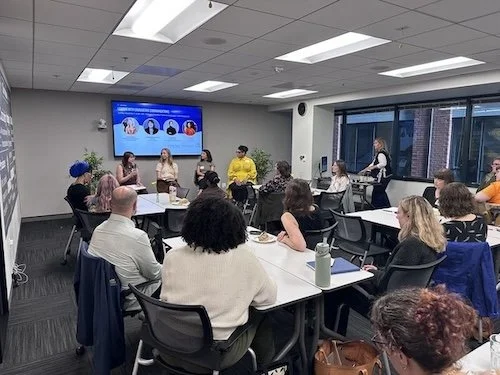
Discussing courageous communications at a Northern California Grantmakers and The Communications Network event
(credit: Dan Cohen via LinkedIn)
Of course, changing the conversation doesn't mean we've changed every institution. There's still a considerable distance between embracing the language of trust and fundamentally changing how power is exercised. But shifting what people consider normal or possible is itself a meaningful form of progress.
This exploration has reinforced something important about narrative change: it rarely belongs to any one organization or movement. Ideas take hold when they're repeated, adapted, and reinforced by different voices, often becoming harder to trace to any single source as their influence grows.
That's helped me see the Trust-Based Philanthropy Project's role a little differently. Our goal isn't necessarily to have everyone identify with trust-based philanthropy in name, but to help create the conditions in which its underlying values become increasingly embedded in how philanthropy operates. In that sense, the movement's influence may be much greater than what we can measure through explicit adoption of its language or framework.
Trust Across Borders: Different Cultures, Shared Strategies
Another energizing aspect of my fellowship has been convening leaders who are advancing trust-based approaches in different parts of the world. I've been struck by how much we have in common—and how cultural context can influence the case for trust-based philanthropy. As a cultural anthropologist, I find this to be especially fascinating. Trust isn't a culturally neutral concept. How people understand relationships, power, reciprocity, and accountability is shaped by history, social norms, and political context.
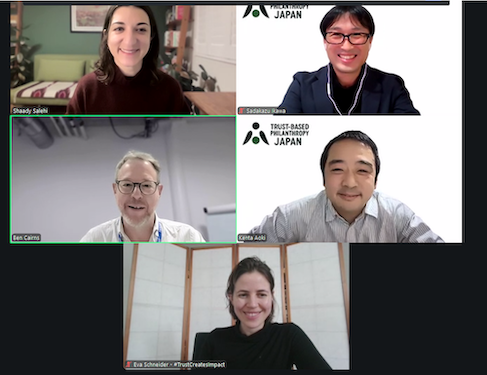
Faces of the global TBP community
For example, colleagues at Trust-Based Philanthropy Japan have shared how values of relationship-building, reciprocity, and respect already resonate deeply in the Japanese cultural context. Yet many philanthropic practices have been modeled after U.S. conventions that don't necessarily reflect those values. So, rather than having to convince people of the importance of trusting relationships, much of their work involves helping funders recognize and rethink the institutional structures and power dynamics that are getting in the way.
In Denmark, growing interest in trust-based philanthropy similarly draws on a Scandinavian tradition of collaboration and collective responsibility. This offers an interesting contrast to the U.S., where a heavy cultural emphasis on individualism has led us to focus more on demonstrating why a collaborative, humble, partnership-oriented approach can yield better results. In our case-making in the U.S., we’ve found it helpful to articulate the benefits to funders: stronger relationships that enable more honest communication, better information, and ultimately improved ability to deliver on the foundation’s mission.
What's been especially valuable about these cross-national exchanges is discovering that while the cultural case for trust-based philanthropy may differ, the strategies for shifting philanthropic norms are often remarkably similar: bringing funders together, building shared language, elevating examples of what's possible, and creating opportunities for peer learning. It's helping me appreciate that changing philanthropy isn't simply about persuading individual institutions to work differently, but about cultivating the relationships, learning opportunities, and collective momentum that can tip the scales toward change.
“Our goal isn’t necessarily to have everyone identify with trust-based philanthropy in name, but to help create the conditions in which its underlying values become increasingly embedded in how philanthropy operates.”
Looking Ahead: What If We Applied Trust-Based Values Beyond Grantmaking?
These reflections are also unfolding at a time when the landscape of wealth and capital is changing dramatically. AI is accelerating the creation and concentration of wealth, economic inequality continues to grow, and nonprofits are navigating an increasingly uncertain funding environment. At the same time, new generations of donors and emerging approaches to mobilizing capital are creating opportunities to rethink how resources can be used for social good.
These shifts have us wondering whether the narrative we've helped advance at the TBP Project might have relevance far beyond traditional grantmaking. We've spent years making the case that philanthropy's practices and power structures aren't neutral or fixed. What might happen if we applied that same thinking to the full range of capital that philanthropic institutions and other wealth holders control? How might trust-based values inform decisions about investments, assets, ownership, and the ways capital flows into communities?
“How might trust-based values inform decisions about investments, assets, ownership, and the ways capital flows into communities?”
These questions are helping shape our next set of explorations around what we're beginning to call trust-based capital.
Building from the principles of trust-based philanthropy, trust-based capital offers an approach to using money and assets for social good that is grounded in trust, built on relationships, and shares power with those closest to the solutions. We’re beginning to document examples and are excited to apply what we've learned from building the TBP movement to a much wider landscape of institutions, resources, and relationships.
The more I explore these possibilities, the more I'm reminded that the values at the heart of trust-based philanthropy have the potential to take us well beyond where we started.
Shaady Salehi is Senior Fellow at the Trust-Based Philanthropy Project.